If you're evaluating lithium-ion battery solutions for your commercial project, understanding the difference between lfp and nmc battery chemistries is critical to making the right investment decision. As battery technology continues to evolve rapidly, the performance and cost gaps between these two dominant chemistries are shifting, making the choice more nuanced than ever.
In this expert guide, we'll break down lfp vs nmc battery chemistry, performance, safety, total cost of ownership (TCO), and ideal applications using 2026 market data from BloombergNEF (BNEF) and the International Energy Agency (IEA). We'll also answer the question every B2B buyer asks: which is better nmc or lfp battery for your specific use case.
Before diving into performance comparisons, it's essential to understand the core chemical differences that drive the unique characteristics of lfp and nmc battery chemistries.
An nmc battery, or lithium nickel manganese cobalt battery, uses a lithium nickel manganese cobalt oxide (LiNiₓMnᵧCo_zO₂) cathode. The nmc battery meaning refers to the three transition metals that make up the cathode, whose ratios can be adjusted to prioritize different performance characteristics:
An LFP battery, or lithium iron phosphate battery, uses a lithium iron phosphate (LiFePO₄) cathode. Unlike NMC batteries, LFP cells do not contain nickel or cobalt, which are expensive and subject to supply chain volatility.
LFP batteries have a more stable olivine crystal structure, which gives them exceptional thermal stability and long cycle life. They accounted for 41% of global lithium-ion battery production in 2025, with demand growing rapidly in energy storage and low-cost EV applications. 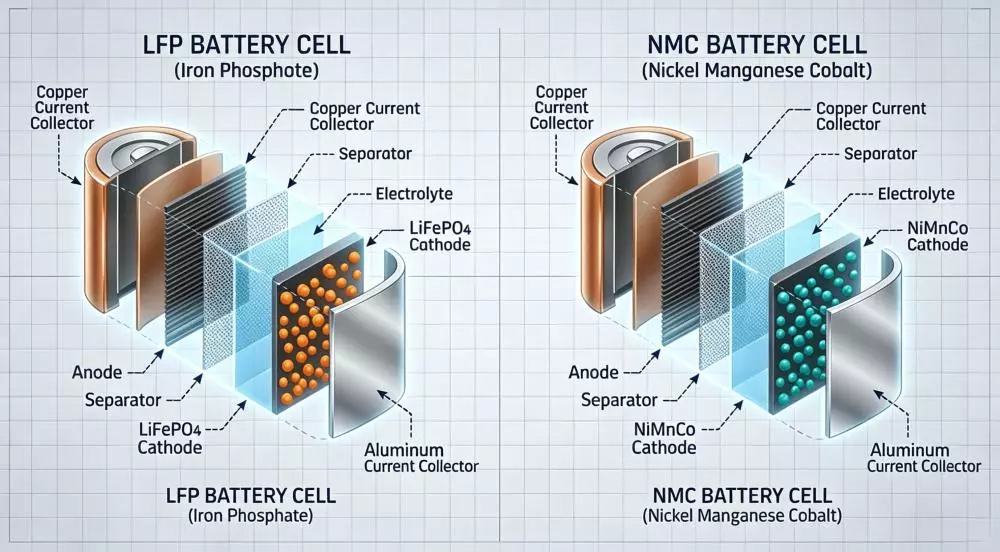
The table below compares the core technical specifications of nmc vs lfp battery chemistries based on 2026 mass-production cells:
| Parameter | NMC Battery (Average) | LFP Battery (Average) | Key Difference |
| Nominal Cell Voltage | 3.6V – 3.7V | 3.2V | NMC delivers 15% higher voltage per cell |
| Gravimetric Energy Density | 180 – 300 Wh/kg | 120 – 200 Wh/kg | NMC has 40-50% higher energy density |
| Volumetric Energy Density | 400 – 600 Wh/L | 250 – 400 Wh/L | NMC requires 30-40% less space |
| Cycle Life (80% SOH) | 1500 – 3000 cycles | 3000 – 8000 cycles | LFP lasts 2-3x longer |
| Thermal Runaway Temperature | 210°C | 320°C | LFP is significantly more thermally stable |
| Low-Temperature Capacity (-20°C) | 75 – 85% | 55 – 65% | NMC performs 20-30% better in cold |
| Fast Charging Capability | 1C – 5C | 0.5C – 3C | High-nickel NMC charges faster |
| Depth of Discharge (DoD) | 80 – 90% | 90 – 95% | LFP can be discharged more deeply |
For B2B buyers, the economic comparison extends far beyond upfront cell cost. The nmc vs lfp battery economic equation depends heavily on your application, operating conditions, and project lifespan.
According to BNEF's 2026 Q2 Battery Price Survey:
LFP cells have a 26% upfront cost advantage due to their lack of nickel and cobalt. However, this advantage narrows at the pack level, as LFP's lower energy density requires more structural materials and cooling systems.
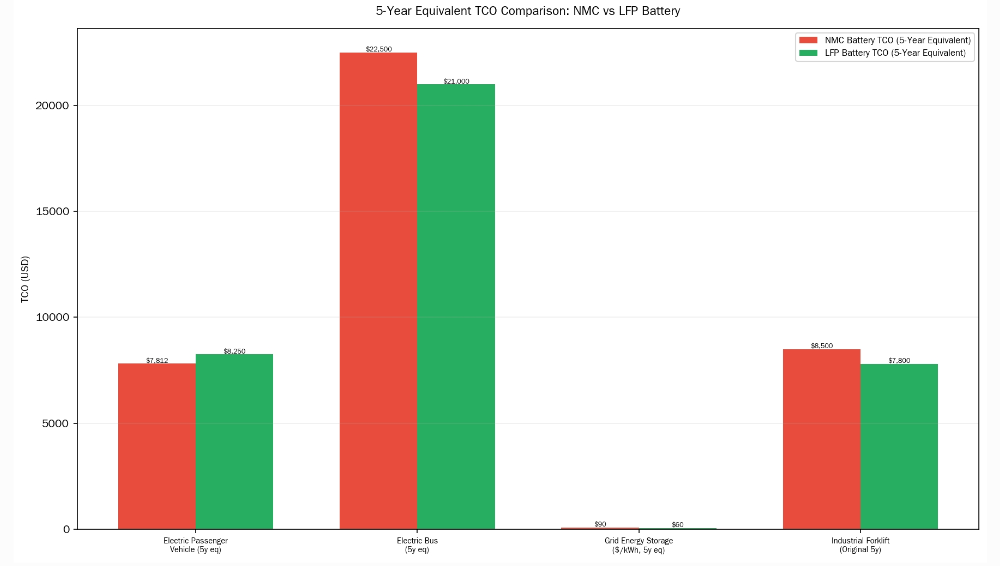
| Application | NMC Battery TCO | LFP Battery TCO | Better Choice |
| Electric Passenger Vehicle (150k km lifespan) | $12,500 | $13,200 | NMC |
| Electric Bus (500k km lifespan) | $45,000 | $42,000 | LFP |
| Grid Energy Storage (10-year lifespan) | $180/kWh | $120/kWh | LFP |
| Industrial Forklift (5-year lifespan) | $8,500 | $7,800 | LFP |
Key takeaway: NMC has lower TCO for short-lifespan, mobile applications where weight and space are critical. LFP has lower TCO for long-lifespan, stationary applications where cycle life is the primary driver.
LFP batteries have a more stable and sustainable supply chain:
NMC batteries face ongoing supply chain volatility due to nickel and cobalt prices, which can fluctuate by 30-50% in a single year. For real-time nmc battery price updates and bulk pricing, contact our team for a personalized quote.
The question of which is better nmc or lfp battery has no universal answer – it depends entirely on your application requirements.
Our engineering team specializes in designing custom hybrid battery systems optimized for your specific project requirements.
Q1: What is the main difference between lfp and nmc battery?
A1: The primary difference between lfp and nmc battery is the cathode material: NMC uses nickel-manganese-cobalt oxide, while LFP uses lithium iron phosphate. This fundamental difference leads to tradeoffs in energy density, cycle life, cost, and thermal stability.
Q2: Which battery is safer, LFP or NMC?
A2: LFP batteries are inherently safer due to their more stable crystal structure and higher thermal runaway temperature. However, high-quality NMC batteries with proper safety systems are also very safe for most applications.
Q3: Will LFP replace NMC in electric vehicles?
A3: While LFP is gaining market share in low-cost EVs, NMC will remain the dominant chemistry for premium and long-range EVs for the foreseeable future, due to its superior energy density. IEA projects NMC will still account for 50% of EV battery sales in 2030.
Q4: What is an NMC Battery?
A4: To answer the most common question what is nmc battery: An nmc battery, also known as a lithium nickel manganese cobalt battery, is a type of lithium ion battery that uses a cathode made from a combination of nickel, manganese, and cobalt.
Q5: Can You Use LFP and NMC Batteries Together?
A5: Yes! Many B2B projects use a combination of lfp and nmc battery and nmc and lfp battery system designs to get the best of both worlds.
Q6: What is the best nmc battery care practice to maximize lifespan?
A6: Proper nmc battery care is essential to extend cycle life and maintain performance. Key practices include avoiding deep discharges below 10% SOC, using manufacturer-approved chargers, storing batteries at 20-30% SOC in cool, dry environments, and avoiding exposure to extreme temperatures (<-20°C or >55°C). Following these guidelines can increase battery lifespan by up to 30%.
Contact our sales team today for a customized quote based on your specific requirements. We offer competitive pricing for both nmc battery for sale and LFP battery solutions, with global shipping and local support available.
Shenzhen Starmax Energy Technology Co., Ltd.
WhatsApp/Wechat/Mobile: +86 14704451321
Email: support@szxhbattery.com
Website: www.szxhbattery.com
Related Articles:
What Is A Nmc Battery?