Case Details
Introduction
Sodium‑ion batteries (SIBs) have emerged as a promising alternative to lithium‑ion batteries (LIBs), particularly for large‑scale energy storage applications. One of the most frequently asked questions about this emerging technology concerns its behavior under high‑temperature conditions. Specifically, are sodium‑ion batteries truly heat‑resistant, and are they less prone to the dreaded "swelling" (bulging) phenomenon that plagues many lithium‑based batteries? The answer, based on the latest research, is nuanced: sodium‑ion batteries generally exhibit superior thermal stability and higher onset temperatures for thermal runaway compared to lithium‑ion batteries. However, they are not immune to heat‑induced degradation and gas generation, which are the primary causes of swelling. Under extreme abuse conditions, such as overheating or overcharging, sodium‑ion batteries can actually generate more gas and reach higher peak temperatures than their lithium‑ion counterparts.
This article synthesizes findings from peer‑reviewed academic literature, including recent studies published in 2025 and 2026, to provide a comprehensive, evidence‑based assessment of high temperature resistant sodium ion energy storage cells behavior under high‑temperature conditions.
Understanding Battery Swelling The Gas Generation Mechanism
To understand whether sodium‑ion batteries are prone to swelling, we must first understand what causes swelling in batteries. Swelling, or bulging, is primarily caused by the generation and accumulation of gas inside the battery cell. This gas increases internal pressure, leading to physical deformation, which can damage the device, create safety hazards, and degrade battery performance.
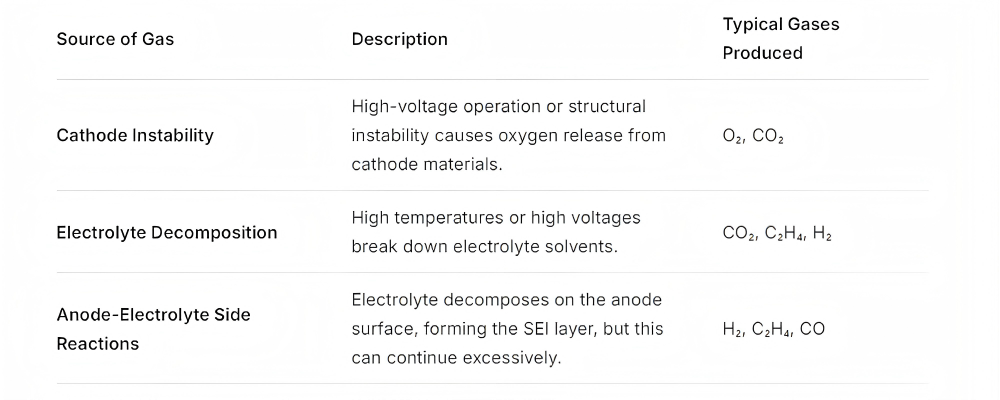
In both lithium‑ion and sodium‑ion batteries, gas generation originates from three primary sources. Critically, high temperatures significantly accelerate all of these chemical reactions. The rate of electrolyte decomposition and side reactions follows the Arrhenius equation, meaning that the reaction rate increases exponentially with temperature. Therefore, heat is the single most important factor driving gas generation and, consequently, swelling in any battery chemistry.
The Heat Resistance of Sodium‑Ion Batteries A Comparative Analysis
Superior Onset Temperatures
When comparing sodium‑ion batteries to the industry‑standard lithium iron phosphate (LFP) batteries, a series of controlled experiments have revealed a complex but generally favorable safety profile for SIBs.The most critical parameter for assessing thermal safety is the "self‑heating onset temperature" (T_onset), which is the temperature at which the protective Solid Electrolyte Interphase (SEI) layer on the anode begins to break down, triggering a cascade of exothermic reactions. A comprehensive 2025 study using an Accelerating Rate Calorimeter (ARC) found that sodium‑ion cells at 100% state of charge (SOC) have a significantly higher T_onset than lithium‑ion cells.- Sodium‑ion battery T_onset: 102.17 ± 2.81 °C- Lithium‑ion battery T_onset: 88.86 ± 2.91 °CThis means that a sodium‑ion battery can withstand a higher temperature before its internal safety mechanisms begin to fail. The same study also found that the temperature required to trigger full thermal runaway (T_tr) is higher for SIBs (220.92 ± 2.85 °C) than for LIBs (191.23 ± 2.30 °C). This superior thermal stability is attributed to the larger ionic radius of sodium and the different chemical composition of its SEI layer, which requires more energy to decompose. 160Ah prismatic sodium ion cell for stationary energy storage delivers reliable thermal stability for off‑grid solar projects.
The Paradox Milder Runaway More Gas
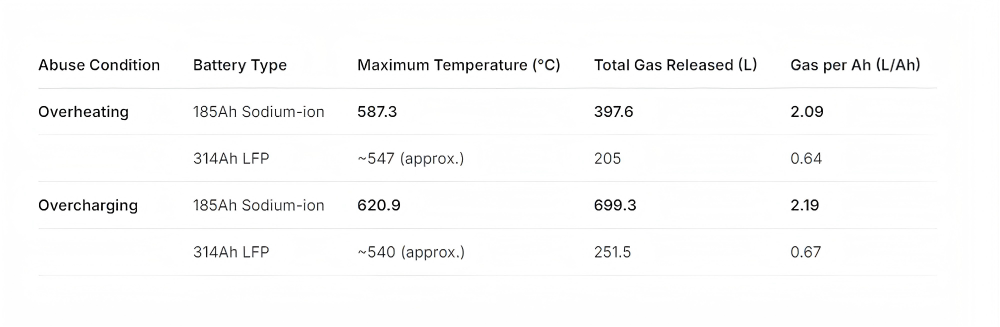
While SIBs are more resistant to initiating thermal runaway, their behavior during a runaway event is different. A pivotal 2026 study directly compared the thermal runaway of large‑capacity 185Ah sodium‑ion batteries (with a CFM cathode) against 314Ah LFP batteries. The results were striking and challenge the simple narrative that SIBs are always safer.
Under both overheating and overcharging abuse conditions, the sodium‑ion batteries reached significantly higher maximum temperatures and generated substantially more gas than the LFP batteries.Sodium‑ion batteries released over three times more gas per ampere‑hour (Ah) of capacity than LFP batteries under both overheating and overcharging scenarios. This excessive gas generation is the direct chemical cause of severe swelling and poses a significant explosion risk, as many of the gases (H₂, CO, CH₄, C₂H₄) are highly flammable. The study concluded that while SIBs show promise, their development must prioritize improving heat dissipation and charging protocols to mitigate these risks. High safety sodium ion battery pack with smart BMS thermal management effectively reduces gas accumulation and swelling risk under harsh operating environments.
Mitigation Strategies How to Prevent Swelling and Improve Heat Resistance
The good news is that the scientific community is not merely documenting these problems; it is actively developing effective solutions. The key to making sodium‑ion batteries truly heat‑resistant and swell‑free lies in advanced materials engineering.
Electrolyte Engineering
The most promising approach to improving high‑temperature performance is the design of novel electrolytes. The conventional electrolyte salts and solvents are often the weakest link, decomposing at high temperatures to produce gas.
A breakthrough 2025 study introduced a "dynamic molecular docking" strategy to create an electrolyte that is both non‑flammable and highly stable at elevated temperatures. This novel ternary electrolyte (TEP‑PC‑PhCF₃) enabled a sodium‑ion pouch cell to achieve remarkable performance at a scorching 55 °C, retaining 86.9% of its capacity after over 1,000 charge‑discharge cycles, with "greatly reduced gas generation". This represents a significant leap forward in creating inherently heat‑resistant SIBs.Another avenue is the use of specific electrolyte additives. Research has shown that using sodium salts like NaFSI and additives like NaODFB can create a more robust and thermally stable SEI layer on the anode. This improved SEI delays breakdown from around 95°C to as high as 180°C, significantly enhancing the battery's resistance to heat‑triggered side reactions and gas generation. Long cycle life sodium ion battery cell optimized for hot climate energy storage adopts upgraded thermally stable electrolyte formula.
Anode and Cathode Material Optimization
The choice of materials for the positive and negative electrodes is equally critical. Polyanionic compounds, such as Na₃V₂(PO₄)₂F₃ (NVPF), are known for their strong covalent bonds and excellent thermal stability, making them a safer choice than layered oxide cathodes. On the anode side, while hard carbon is the standard, its surface needs to be protected. Advanced electrolyte formulations help form that critical protective layer, preventing it from catalytically decomposing the electrolyte and generating gas at high temperatures. Custom sodium ion energy storage system for commercial solar projects uses high thermal stability cathode materials for long‑term safe operation.
Conclusion A Nuanced Verdict on Heat and Swelling
So, are sodium‑ion batteries heat‑resistant and less prone to swelling? The evidence provides a clear, three‑part verdict:1. Yes, they are more heat‑resistant in normal operation. Sodium‑ion batteries possess superior inherent thermal stability, with higher thresholds for SEI decomposition and thermal runaway initiation compared to lithium‑ion batteries. This makes them a safer choice for applications in warmer climates.2. No, they are not immune to swelling and can be more severe in failure. Under extreme abuse conditions like severe overcharging or direct overheating, sodium‑ion batteries can generate significantly more gas than LFP batteries, leading to a much greater risk of severe swelling, leakage, and even violent explosion due to the high volume of flammable gases.3. The future is bright but dependent on engineering. The safety and high‑temperature performance of SIBs are not fixed properties but are being dramatically improved through materials science. Advanced electrolytes and robust electrode designs are effectively suppressing gas generation and enabling stable operation even at 55°C.In summary, the narrative is not that one technology is "safe" and the other "unsafe." Rather, sodium‑ion batteries offer a different safety profile. They are more robust against heat‑induced failure under normal conditions, but their failure mode can be more severe, characterized by intense heat and massive gas release. For consumers and industries alike, this means that with proper battery management systems (BMS) and thermal management, SIBs represent a viable and promising alternative for a sustainable energy future. However, simply assuming they will never swell or overheat would be a dangerous oversimplification. The technology is rapidly evolving, and next‑generation SIBs, equipped with advanced, thermally stable electrolytes, are poised to deliver on the promise of both safety and performance. Cost effective sodium ion battery solution for large scale energy storage plant balances high temperature safety and economic benefits.
FAQ
1. Do sodium ion batteries swell easier than LFP batteries
Under regular operating temperatures and normal charging conditions, sodium‑ion batteries show better thermal stability and lower swelling risk. Once exposed to extreme abuse such as overcharging or severe overheating, sodium‑ion cells can produce far more flammable gas than LFP batteries which may cause serious bulging. Equipping sodium ion battery pack with professional BMS thermal protection system can greatly avoid this risk.
2. What is the maximum working temperature for sodium‑ion batteries
Standard commercial sodium‑ion cells can work stably at ambient temperatures up to 55°C. Products using upgraded thermally‑stable electrolyte and electrode materials can sustain longer‑term high‑temperature operation. You can select our high temperature resistant sodium ion cell for hot region solar storage for tropical and desert‑area projects.
3. Can I replace LFP batteries directly with sodium‑ion batteries in my solar storage system
Physical dimensions and voltage curves can be matched, but sodium‑ion batteries require a dedicated BMS and thermal cooling setup to control gas generation risks under abnormal conditions. Our team provides one stop sodium ion solar energy storage kit including matched BMS and thermal management components.
4. Are sodium‑ion batteries safer for warm climate residential energy storage
Compared with conventional lithium‑ion batteries, sodium‑ion batteries have a higher self‑heating onset temperature so they are more resistant to heat‑triggered failure during daily operation. It is still necessary to install proper ventilation and temperature monitoring. Our residential sodium ion battery energy storage solution is designed specially for high‑temperature residential scenarios.
5. How to reduce gas generation inside sodium‑ion battery cells
Three main solutions are available: using high‑stability non‑flammable electrolyte, adopting thermally robust cathode materials and installing accurate BMS to avoid overcharge and overheating. Contact us for details of our low gas generation A grade sodium‑ion prismatic cell.