As the global energy transition accelerates, market demand for cost effective stationary energy storage batteries keeps growing. Many project buyers are actively seeking reliable alternatives to conventional lithium‑ion batteries. Among emerging new battery technologies, commercial sodium‑ion battery cells have attracted wide industry attention, thanks to rich raw material reserves and expected long‑term cost benefits.
This technical brief analyzes the Hina 2.85V 160Ah prismatic sodium‑ion cell. It delivers a practical side‑by‑side evaluation against mainstream lithium chemistries including LFP lithium iron phosphate battery and NMC ternary lithium‑ion battery, helping system integrators and project owners make informed battery selection decisions.
The Hina 160Ah prismatic cell is a mass‑produced sodium‑ion storage cell already applied in light electric vehicles and grid stationary energy storage systems across China. Independent teardown tests completed by RWTH Aachen University verify its tabless double‑aluminum current collector structure. This cell design draws on proven high‑end lithium‑ion cell architecture, bringing low internal resistance and even thermal distribution across the cell body.
Key specifications are summarized below: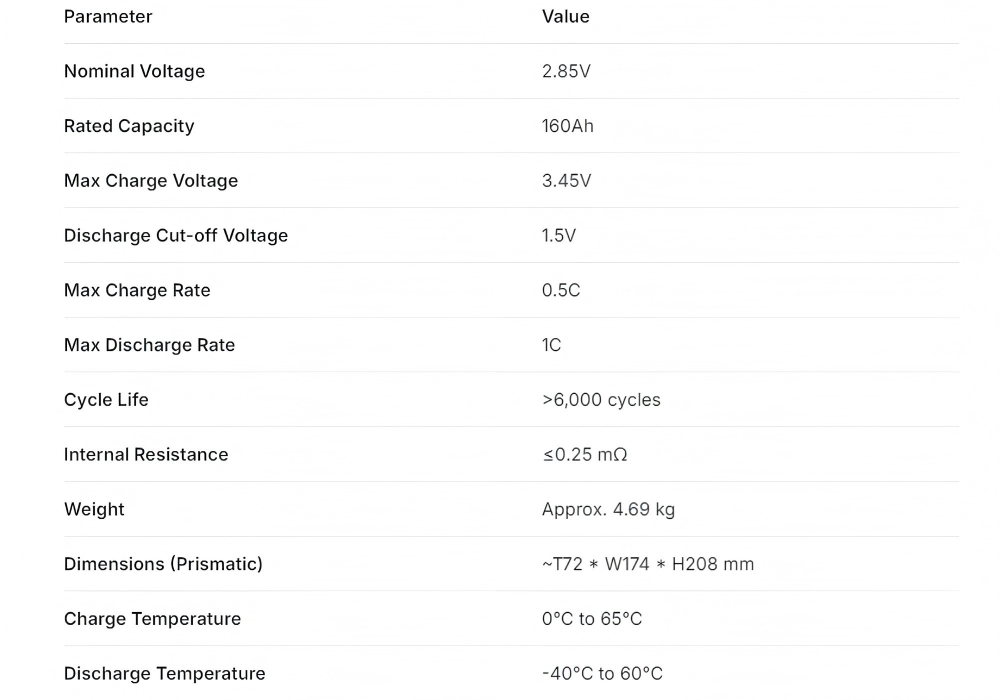
Winner: Lithium‑Ion.
Energy density is still the main technical bottleneck for sodium‑ion technology. Restricted by sodium element’s larger atomic mass and ionic radius, the Hina cell reaches 100‑160 Wh/kg. Independent lab testing records real‑world performance around 145 Wh/kg. This figure falls behind standard LFP battery cell (150‑210 Wh/kg) and has a clear gap against NMC lithium‑ion cells (240‑350 Wh/kg).
For electric vehicle projects, lower energy density directly translates into shorter driving mileage. Vehicles powered by sodium‑ion batteries normally deliver roughly 250 km per full charge, while comparable lithium‑ion powered vehicles achieve longer driving ranges.
Comparable performance.
Official cycle rating for the Hina sodium‑ion cell exceeds 6000 cycles, which matches typical performance of long cycle life LFP cells (3000‑6000 cycles). Real‑world field data shows sodium‑ion performs outstandingly in grid scale energy storage projects. It tolerates deep discharge cycles well and suppresses dendrite growth effectively. Under grid storage operating conditions, its service life may run up to 33% longer than LFP cells.
Still, third‑party consumer testing indicates sodium‑ion battery degradation could accelerate under unstable variable load conditions when compared with top‑grade LFP products.
Winner: Sodium‑Ion.
Superior cold‑weather performance is the most prominent strength of sodium‑ion chemistry. The Hina 160Ah sodium‑ion cell retains 88% capacity output at ‑20°C. Industry test data shows qualified sodium‑ion cells can hold over 90% capacity at ‑40°C. By contrast, ordinary LFP energy storage cells drop to around 60% capacity under the same cold environment.
This feature makes sodium‑ion an ideal pick for cold climate energy storage systems, without requiring complex and costly supporting thermal management hardware.
Winner: Sodium‑Ion.
Sodium‑ion prismatic cells possess inherent chemical stability advantages. They carry much lower thermal runaway risk. Cells can endure full zero‑volt discharge without permanent damage. The internal aluminum‑based current collector replaces copper material, delivering higher safety level under fault scenarios.
Even though LFP already enjoys better safety performance compared to NMC ternary products, sodium‑ion provides extra safety margin for large‑capacity commercial energy storage battery packs.
Theoretical Winner: Sodium‑Ion with practical limitations.
Sodium resources are approximately 1000 times more abundant than lithium, and raw sodium materials can be extracted from seawater. Nevertheless, actual market economics in 2026 remain complicated.
Oversupply has pushed down bulk LFP cell pricing to around $50/kWh. Current commercial sodium‑ion cell prices sit between $70‑110/kWh. At today’s production scale, sodium‑ion remains more expensive. Industry forecasts predict unit cost may fall to $40‑50/kWh as production capacity expands and manufacturing processes mature.
Winner: Lithium‑Ion.
Sodium‑ion shows a sloping discharge voltage curve. Terminal voltage keeps dropping continuously during discharge process. This characteristic may trigger premature low‑voltage cutoff for standard inverters, and part of the cell’s theoretical capacity cannot be utilized unless developers adopt custom‑modified BMS battery management system and inverters.
LFP battery module features a flat stable discharge plateau, enabling nearly full utilization of rated capacity. The whole LFP supporting ecosystem including chargers, BMS units and inverters is fully mature. Sodium‑ion battery projects need specially redesigned supporting hardware components.
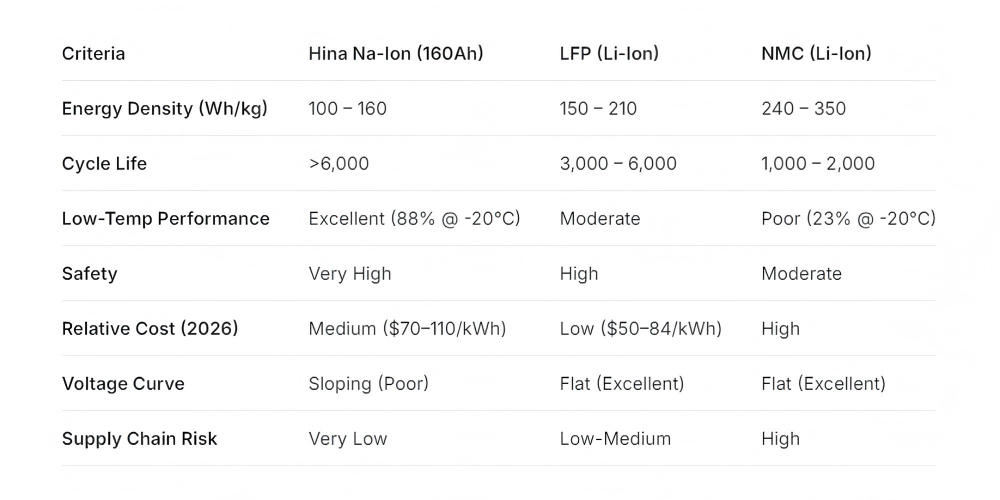
The Hina 2.85V 160Ah prismatic sodium‑ion cell is a practical mass‑produced battery option, yet it cannot completely take the place of lithium‑ion solutions.
LFP lithium iron phosphate battery still holds obvious advantages for projects demanding high energy density, compact footprint, long driving range, portable electronic devices, and systems relying on flat discharge voltage curves.